When we talk about environmental protection, we usually think about recycling, planting trees, reducing pollution or using renewable energy. These are important, of course. But I think there is something we sometimes overlook: the people who live with these environmental problems every day, especially young people, should have more opportunities to be involved in finding solutions.
Being environmentally responsible is not only about changing our individual habits. It is also about the communities we live in, the opportunities we have and whether our opinions are taken into account when decisions are made.
Young people are often encouraged to care about the environment, volunteer and take part in environmental activities. But how often are they actually included in discussions about what needs to change in their neighbourhoods?
This question becomes even more important when we think about young people who already face social or economic barriers and may not have the same opportunities to participate.
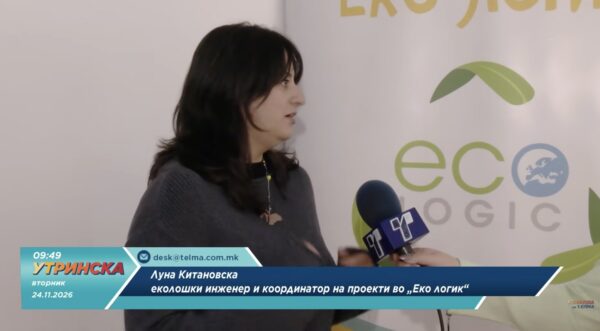
As an environmental engineer and through my work at NGO Eco Logic, I see environmental protection as something that goes beyond technical solutions. Of course, we need better infrastructure, policies and environmental practices, but we also need people to understand these issues and feel that they can contribute. For me, involving young people is particularly important because the decisions we make today will directly influence the communities they will live in tomorrow.
Environmental problems affect people differently
Living in Skopje, air pollution is one of those topics that is almost impossible to avoid, especially during fall and winter periods. We hear about it in the news, discuss it with friends and family, and regularly check air quality levels.
For many people, it has simply become part of everyday life.
But not everyone experiences these problems in the same way.
Some families can afford air purifiers or have the possibility to spend time outside the city when pollution levels are high. Others have no choice but to continue with their daily routines, regardless of the conditions.
The same differences can be seen when we look at access to public transport, green spaces and waste management services.
In some neighbourhoods, people have parks nearby, cleaner public areas and better infrastructure. In others, even finding a safe and pleasant place to walk or spend time outdoors can be difficult.
These differences remind us that environmental problems are not only about nature. They also affect people’s health, opportunities and quality of life.
One thing that stands out to me when thinking about Skopje is how differently people can experience the same city. We all talk about air pollution and the need for a cleaner environment, but the conditions in which people live are not always the same. Some neighbourhoods have more greenery and better-maintained public spaces, while others face challenges that are visible in everyday life. I think we sometimes focus so much on the environmental problem itself that we forget to ask how it affects different groups of people.
I believe this is something we need to consider more seriously when discussing sustainability. Improving the environment should also mean improving living conditions for the people who are most affected by environmental problems.
Green spaces are important, but are they accessible to everyone?
Skopje has public spaces that many of us enjoy, such as City Park, mountain Vodno, Matka Canyon and the areas along the Vardar River. They provide places to walk, cycle, exercise or simply spend time outside.
However, not everyone has easy access to these spaces.
For someone living close to a park, going for a walk might be a normal part of the day. For someone living in a neighbourhood with limited greenery, poor pedestrian infrastructure or unreliable transport connections, it can be much more complicated.
And accessibility is not only about distance.
We also need to consider whether public spaces are safe, whether people with disabilities can use them comfortably and whether young people feel welcome spending time there.
These may seem like small details, but they can make a big difference in how people experience their neighbourhoods.
For example, if a municipality decides to renovate a park, why not ask young people living nearby what they would like to see improved?
Some might suggest more trees or shaded areas. Others may point out the need for better lighting, bicycle parking, drinking fountains or accessible walking paths.
The people who use these spaces regularly often have practical ideas about what is missing.
Including young residents in these discussions would not only help improve public spaces. It would also show them that their opinions are worth listening to.
Environmental education should lead to action
Environmental education plays an important role in helping young people understand climate change, pollution, biodiversity and sustainable living.
But knowing about a problem and being able to do something about it are two different things.
A young person may understand why recycling matters but live in an area without proper recycling facilities. Someone may want to cycle to school or university but avoid doing so because the roads do not feel safe.
In these situations, awareness is not the main problem. The challenge is that young people may not have the necessary opportunities, resources or support to act on what they know.
This is why I think environmental education should also encourage young people to become more involved in their communities.
Clean-up campaigns, tree-planting activities and workshops are useful, but participation should not stop there.
Young people should also have opportunities to identify problems, ask questions, collect information and communicate their ideas to local institutions.
One way to do this is through civic monitoring.
Civic monitoring allows people to observe and document issues in their communities and use that information to suggest improvements.
For example, young people could identify areas where waste regularly accumulates, speak with residents about the problem and share their findings with the municipality.
They could also look at how accessible local parks are, whether cycling routes are safe or what improvements residents would like to see in their neighbourhoods.
These activities give young people practical experience while helping them understand how they can contribute to local decisions.
They also develop useful skills such as communication, teamwork, research and problem-solving.
Through my work at NGO Eco Logic, I have come to appreciate how important it is to create opportunities where young people especially from more rural areas can do more than simply receive information. I believe they need space to ask questions, discuss their ideas and connect environmental topics with their own surroundings. What matters to me is not only whether young people understand an environmental issue, but also whether they feel encouraged and capable of doing something about it. Even small steps towards becoming more involved in their communities can be meaningful.
Not every young person has the same opportunities
When we organise activities for young people, it is easy to assume that everyone has the same possibility to participate.
In reality, that is not always the case.
Some young people are already involved in youth organisations, volunteering programmes and international projects. They know where to find opportunities and feel comfortable applying or taking part.
Others may not have access to the same information or support.
For example, someone living in a rural area may find it difficult to attend activities in the city because of transport costs. A young person who is unemployed may have other immediate priorities. Someone with a disability may face accessibility barriers, while others may simply feel uncomfortable speaking in front of a group.
These are important things to consider when planning youth activities.
If we always work with the same groups of young people, we may unintentionally exclude those who could benefit most from these opportunities.
I think organisations working with young people need to pay more attention to how activities are designed and who they are actually reaching.
Sometimes this means organising activities in smaller communities, working more closely with schools or local organisations, or offering different ways for young people to express their opinions.
Not everyone enjoys public speaking or participating in formal discussions. Some may feel more comfortable using photography, digital tools, storytelling or small-group activities.
What matters is giving young people the possibility to participate in a way that works for them.
For me, one of the biggest challenges in youth participation is making sure that opportunities are not limited to those who are already active and confident. It is easy to reach young people who are familiar with volunteering, projects and youth organisations. But what about those who have never participated in this kind of activity or who do not know where to start? I think we need to make a greater effort to reach them, understand the barriers they face and create an environment where they feel comfortable getting involved. Participation should not depend on someone’s background, financial situation or previous experience.
Inclusion everyone is mentioning but is it correctly implemented? Climate change affects everyone and environmental hazards can be experienced by everyone in different locations. Age, gender, nationality don’t matter, everyone needs to be included in education and take the local action to do something for saving the environment around us.
How ECOSOCIAL VOICES connects these ideas
These are some of the issues we want to address through ECOSOCIAL VOICES – Empowering Unprivileged Young People to Become Influential Ecosocial Voices Through Civic Monitoring, an Erasmus+ Cooperation Partnership in Youth.
The project brings together five organisations from North Macedonia, the Netherlands, Portugal, Bulgaria and Croatia.
Our common goal is to support young people facing fewer opportunities and help them become more actively involved in addressing environmental and social challenges in their communities.
At Eco Logic, we work on environmental education and encouraging more active participation in environmental issues. Through ECOSOCIAL VOICES, we want to connect these two areas in a more practical way.
The project aims to support 100 young people in developing skills and taking part in youth-led civic monitoring activities.
It will also provide training and resources for youth workers, so they can support young people in identifying local problems, gathering information and developing recommendations.
One of the main ideas behind the project is that environmental and social problems are often connected.
We refer to these as ecosocial challenges.
In North Macedonia, we can see these connections in issues such as air pollution, waste management, urban development and access to green spaces.
For example, instead of only talking about why green spaces are important, young people could examine whether different neighbourhoods have equal access to them.
Instead of discussing waste management only as an environmental responsibility, they could look at whether residents have access to the services and infrastructure needed to manage waste properly.
The idea is to encourage young people to look more closely at the problems around them and understand what can realistically be improved.
What I find particularly meaningful about ECOSOCIAL VOICES is that the project brings together two areas that I believe should be more closely connected: environmental protection and social inclusion. As someone with a background in environmental engineering, I understand the importance of addressing environmental problems, but I also believe that solutions need to consider the people affected by them. Through this project, I would like to see young people become more confident in expressing their opinions and more aware of the role they can play in their communities. I hope they will gain not only practical knowledge and skills, but also the confidence to take initiative and communicate their ideas.
Of course, we cannot expect young people to solve environmental problems on their own. Local authorities, institutions, businesses and citizens all have responsibilities.
But young people should have the opportunity to contribute their ideas, especially when decisions directly affect their lives.
Small actions can make a difference
Environmental challenges can sometimes feel overwhelming.
Air pollution, poor waste management and the lack of accessible green spaces are not problems that can be solved overnight.
They require planning, investment, cooperation and long-term commitment.
Still, I think it is important not to underestimate smaller community initiatives.
A group of young people documenting waste problems in their neighbourhood might help bring attention to an issue that has been ignored.
Students examining cycling routes could identify unsafe areas and suggest practical improvements.
Young volunteers speaking with residents about a local park might discover concerns that have never been communicated to the municipality.
These activities may not immediately lead to major changes, but they can be a starting point.
They can also help young people become more confident in expressing their opinions and working with others.
Not every activity needs to result in a new policy or a major environmental improvement to be valuable. Sometimes, simply getting people together to discuss a shared problem is already an important step.
I think we sometimes measure the success of environmental activities only by visible results, such as how much waste was collected or how many trees were planted. These results are important, but I believe there is also value in what young people learn during the process. If an activity encourages someone to ask more questions, share an idea they were previously hesitant to express or become interested in taking part in another community initiative, I would consider that meaningful progress. Changes in confidence and attitudes may not always be immediately visible, but they can have a lasting impact.
The kind of future we want to build
When I think about sustainability, I do not think only about cleaner air, more trees or better waste management.
I also think about the people living in our communities and whether they have the opportunity to influence the places they call home.
In Skopje, and across North Macedonia, there are many environmental issues that need attention. Some require major changes at the institutional level, while others can be addressed through better communication and cooperation within communities.
Young people should be part of both conversations.
They use public transport, walk through their neighbourhoods, spend time in public spaces and experience the consequences of environmental problems in their daily lives.
Their perspectives can help us better understand what needs to change.
As Project Coordinator of ECOSOCIAL VOICES at NGO Eco Logic, what I would personally like to see through this project is young people becoming more comfortable expressing their opinions and recognising that they have something valuable to contribute. I do not expect every participant to become an environmental expert or a community leader. But I hope that, through the activities and experiences offered by the project, they will begin to see themselves as people who can take part in decisions and contribute to positive changes in their surroundings.
I hope that through projects like ECOSOCIAL VOICES, more young people will feel comfortable sharing their ideas, questioning the problems they see around them and becoming involved in their communities.
And I especially hope that these opportunities will reach young people who have not always had the chance to participate.
Because a greener future should not only mean a healthier environment. It should also mean communities where more people feel included, listened to and able to contribute.
This article was prepared in the framework of the ECOSOCIAL VOICES project, an Erasmus+ Cooperation Partnership in Youth (KA220-YOU), implemented by a partnership of five organisations from North Macedonia, the Netherlands, Portugal, Bulgaria and Croatia.
Author: Luna Kitanovska, Environmental Engineer
Project Coordinator – ECOSOCIAL VOICES
NGO Eco Logic